
Chinese arrivals to Nepal are up nearly 70%, but services, infrastructure, and digital marketing haven’t kept pace. A field reflection on what it will take for Nepal to become South Asia’s top destination for Chinese travellers by 2030.

Nepali workers sent home USD 13.26 billion in ten months, yet the economy saved less than ten cents of every dollar it produced. Most of it went into spending, not investment. Economists described this as a poverty trap in 1953. Whether Nepal’s institutions can finally break free from it is still unanswered.

Digital Democracy: How Democracy Is Practiced in the Digital Age, examines how digital platforms, AI, and data are reshaping the relationship between citizens and the state while confronting misinformation, concentrated tech power, and unequal access. Who gets to participate, and who risks being left behind? Besides this, the NEFport spotlights key economic, and policy developments across multiple sectors from June 1, 2026 to August 31, 2026.
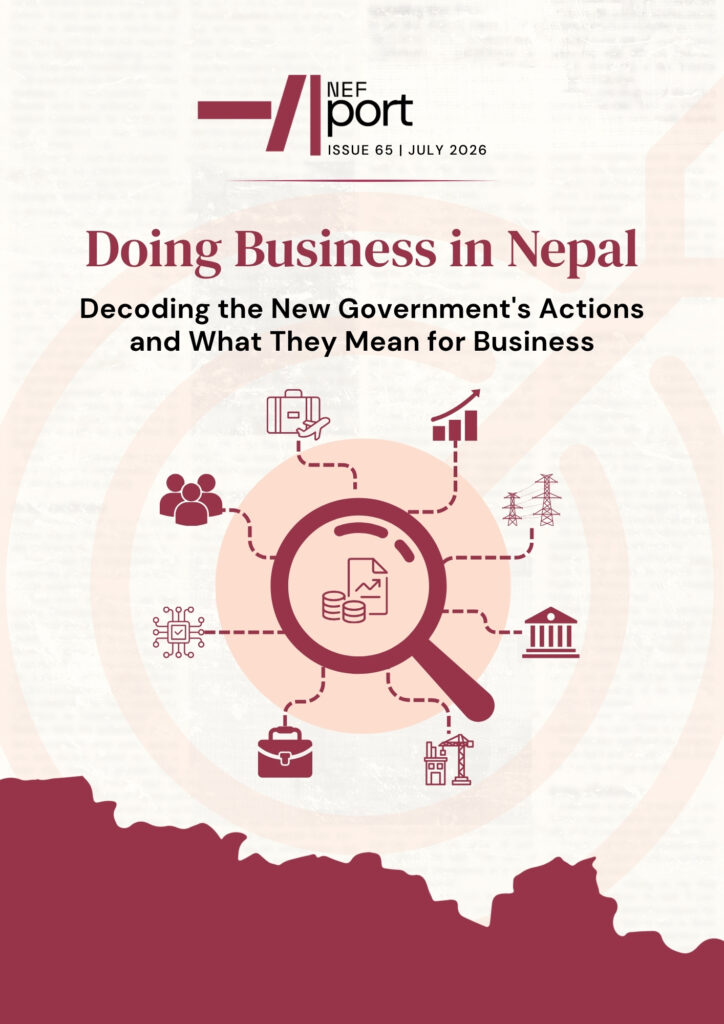
Amid a new political mandate and an ambitious reform agenda, NEFport 65, titled ‘Doing Business in Nepal: Decoding the New Government’s Actions and What They Mean for Business,’ examines how the RSP-led government’s early actions, economic priorities, and record budget could shape Nepal’s business environment. Besides this, the NEFport spotlights key developments across multiple sectors from March 1, 2026 to May 31, 2026.

Amid intensifying climate risks, shifting geopolitical dynamics, and evolving patterns of mobility and connectivity, NEFport 64, titled ‘Himalayan Future Forum 2026 Special: Climate, Community, and Connectivity in a Changing World,’ situates the Himalayan region at the center of global conversations on resilience, cooperation, and sustainable development. Drawing on insights from the Himalayan Future Forum 2026, the publication presents a multidimensional assessment of how climate security, community resilience, and strategic connectivity are shaping the region’s present and future trajectories. In addition, the NEFport spotlights key economic, policy, and sectoral developments from December 1, 2025 to February 28, 2026, with select sections covering updates through mid-March 2026.